
- Procedures
- Documentation
- CRM and tools
Assistants for teams
Your company’s knowledge, ready when your team needs it.
We design assistants connected to internal documents, procedures and systems to find reliable answers and turn them into a useful next step.
From source to decision
The answer may live in many places. Context brings it together.
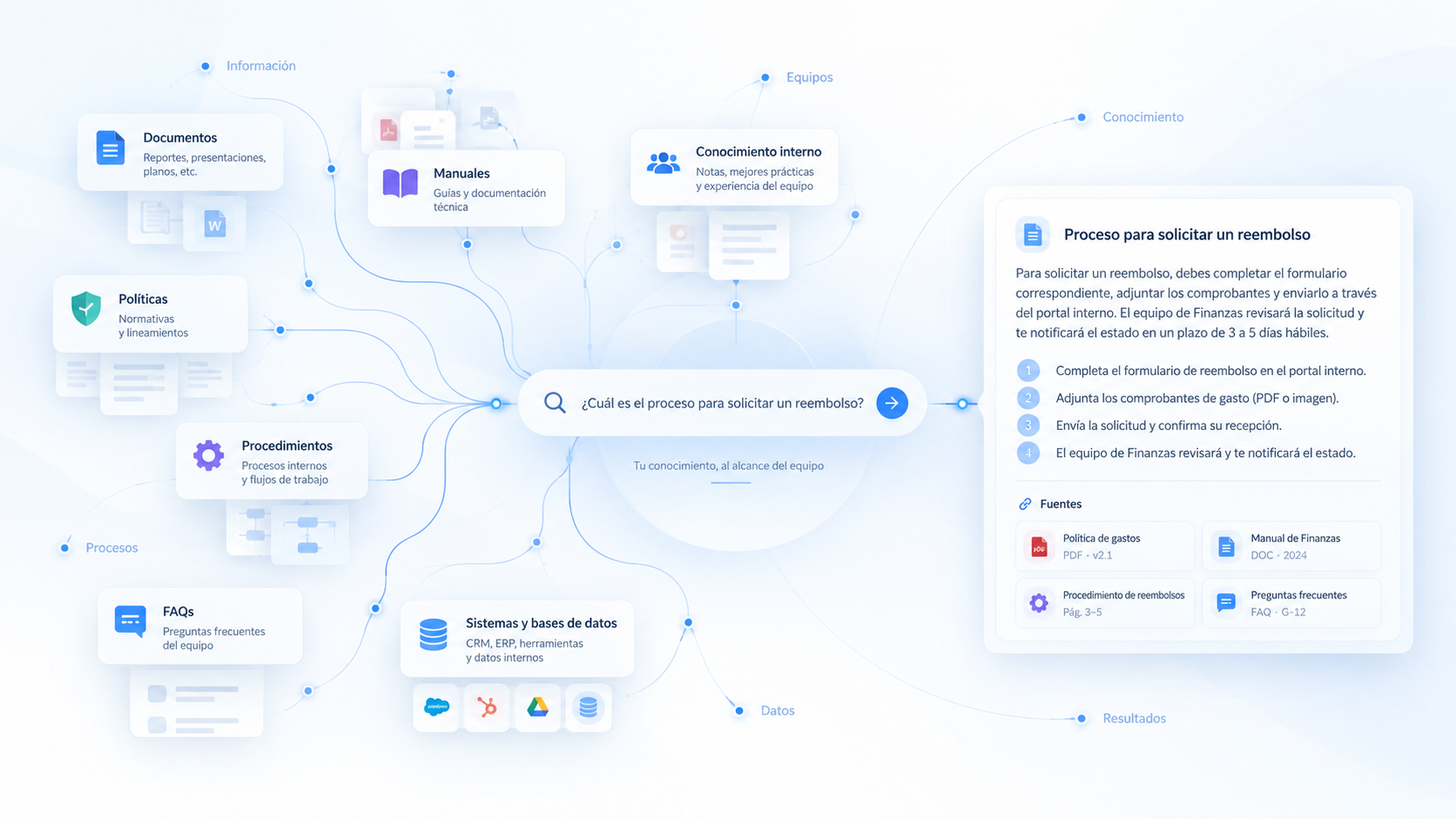
An assistant brings together knowledge spread across documents, guides and systems. People ask in their own words; the system retrieves only relevant information and lets them trace it back to its source.
An answer people can verify
Relevant context, source references and an explanation shaped around the question.
Resolve, prepare or hand off
In day-to-day work
Less time searching. More room to move forward.
Bring a new team member up to speed
Gather guides, processes and internal practices so people can learn how work gets done without relying on a long message chain.
For example“How do I request access to this tool?” → current steps and a link to the internal guide.
Answer an operational question
Find the right procedure, summarise the relevant steps and point to the source so the team can verify them.
For example“Which procedure applies here?” → relevant instructions and a reference the team can check.
Prepare a response or task
Retrieve approved background information and organise what is needed before a person decides what to do.
For example“What should I review before the meeting?” → available context, open items and related sources.
Knowledge with judgement
A useful assistant also knows when not to answer.
We define scope, sources and permissions from the start. If information is missing or a question requires specialist judgement, the assistant makes that clear and hands it off.
Traceable sources
Prioritises approved knowledge and provides references so people can check where an answer came from.
Permission-aware access
Respects the spaces and access levels defined for each team and type of information.
Explicit uncertainty
Asks for clarification, flags missing context or stops when it cannot find a sound basis.
Human review
Sensitive decisions and consequential actions remain under the supervision of responsible people.
A progressive rollout
Start with the knowledge that is hardest to find.
- 01
Choose a starting point
Identify a recurring need and a specific team; there is no need to tackle the whole company at once.
- 02
Organise the sources
Review what is current, who can access it and what needs validation first.
- 03
Design the experience
Define how to ask, show references and decide when to answer, request context or hand off.
- 04
Test and expand
Check answers with the team and add sources or use cases once the journey proves useful.
Assistants for teams
Frequently asked questions
Does the assistant automatically learn from every document?
We do not connect content without a clear approach. We agree on approved sources, permissions and how they stay current; answers should rely on that context.
Can it respond differently for each team?
Yes. Permissions, sources and experiences can vary by role, subject to the company’s systems and policies.
What happens when it cannot find a reliable answer?
We design it to recognise missing context: it can ask a follow-up, explain the limitation or pass the question to a person.
Does all documentation need to be perfect?
No, but it helps to start with a focused, reliable set. A discovery review can identify which sources are ready and which need organising first.
The next step
Start with the question that interrupts your team most often.
We’ll look at where that knowledge lives, who needs it and what should happen once it is found.
Identify a first use caseExplore AI and automation